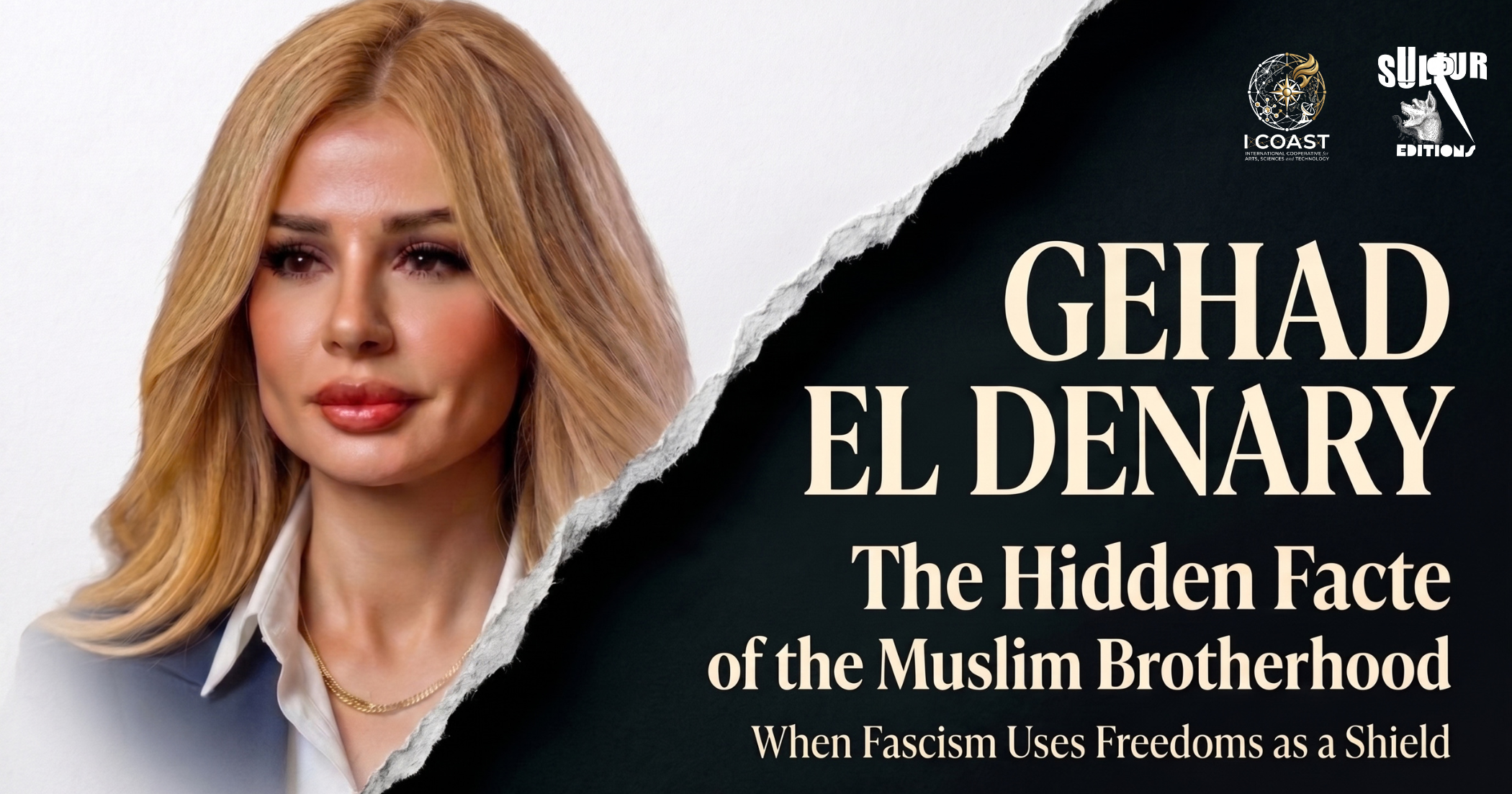
“The Muslim Brotherhood”: The Organization That Assassinated the Symbols of Thought and Enlightenment in Egypt

Sulfur Editions Introduction
Driven by our unwavering commitment to enlightenment and cultural integrity, and our ethical duty to protect societies from covert fascisms that infiltrate to cause social unrest and spread religious extremism; Sulfur Editions, in collaboration with the International Cooperative for Arts, Sciences and Technology (I-COAST) and Egyptian writer and researcher Jihad Eldenary, proudly announces the launch of the hard-hitting investigative series: “The Other Face of the Muslim Brotherhood”.
While Western democracies open their doors to pluralism, this group maliciously exploits the liberal climate in Europe and America. Today, we are facing an organization operating through undeclared blocs and individuals who deeply infiltrate the European cultural sphere, human rights institutions, and civil society. They operate under false liberal masks, feigned tolerance, and deceptive claims of openness. This systematic infiltration is a sinister cover used to launder hundreds of millions of dollars that ultimately serve terrorist objectives and establish networks of influence that threaten the security of Western societies.
This investigative series—published in English and French—aims to confront European and American readers across the political spectrum with the unvarnished truth. We will meticulously deconstruct how this group operates, how they infiltrate free societies, and how they now wear the cloak of culture, creativity, and enlightenment to conceal their bloodthirsty intentions, exactly as they previously used the cloak of religion to pass their agendas.
Based on rigorous investigations and undeniable historical documents, this series relies on foundational reference files, including the article “The Muslim Brotherhood”: The Organization That Assassinated the Symbols of Thought and Enlightenment in Egypt, to confirm the fact that they cannot disavow their blood-stained history. In Egypt, they did not merely act as self-appointed guardians over freedom of thought; they chose “murder” as their final solution and preferred choice for settling any intellectual dispute.
Our articles provide documented evidence of how this group targeted icons of thought and enlightenment through a series of systematic assassinations:
The Assassination of Thinker Farag Foda: Murdered by treacherous bullets simply for explicitly rejecting their extremist “Islamic State” project and fighting their attempts to drag the country into a closed religious state.
Shedding the Blood of Novelist Youssef El Sebai: Assassinated in cold blood for supporting peace choices, directly contradicting the doctrine of a group that feeds on conflicts and the trade of blood.
The Attempted Murder of Nobel Laureate Naguib Mahfouz: Stabbed in the neck over a novel they had never read, executing takfiri fatwas that perfectly embody a culture of blind obedience and the cancellation of the mind.
Sulfur Editions is opening these files to strip this organization of the false enlightenment claims that enabled it to infiltrate Western cultural institutions. We invite the public and decision-makers in the West to follow this documentary series to deconstruct the intellectual and criminal offenses of this faction, and to realize the scale of the fascist threat lurking behind deceptive masks of tolerance.


They killed Farag Foda when he rejected the “Islamic State.”
They assassinated Youssef El Sebai when he supported the peace agreement.
They stabbed Naguib Mahfouz over a novel they never read.
“The Muslim Brotherhood”: The Organization That Assassinated the Symbols of Thought and Enlightenment in Egypt
By Jihad Eldenary – Egyptian Writer and Researcher

Feigning tolerance, borrowing the language of openness, and falsely claiming to respect the opinions of others are nothing but deceptive masks that members of the Muslim Brotherhood attempt to wear and export, especially during their presence within Western cultural circles. They understand the rules of the promotional game very well, penetrating societies through the very gateways that appeal to them. When addressing the West, they don the mask of culture, creativity, and enlightenment as a new cloak to conceal the wickedness of their bloodthirsty intentions. This is precisely how they dealt with Egyptian society before ascending to power, when they used the cloak of religion as a shield for their practices, recognizing the innately religious nature of the Egyptian people and their inclination toward a tolerant Islam. That was the loophole through which they crept out of their burrows, waving the slogan “Islam is the Solution,” while in reality, they were as far removed as possible from understanding the true spirit of Islam and its sublime values.
Today, the exact same phenomenon is repeating itself, albeit with a change of cloak. Undeclared blocs and organizations are actively operating, manifesting as scattered individuals who deeply infiltrate the European cultural sphere, claiming to be enlightened and championing the freedom of creativity. At times, they wage imaginary battles against artistic censorship, and at others, they declare their support for bold literary and artistic works, adopting enlightenment as a “new ideological suit” to restore their image and whitewash their history. But what about that history?
Can these individuals disavow history or disassociate themselves from what their group has committed against the march of Egyptian creativity over the decades? They did not merely appoint themselves as guardians and censors over the freedom of thought; they positioned themselves as judges and rulers over our culture, arts, and literary heritage. Their tyranny did not stop at the boundaries of objection or defaming creators who opposed their views; rather, “murder” was—and remains—their preferred choice and ultimate solution for settling any intellectual dispute. History stands witness to a series of systematic assassinations that targeted the pioneers of thought and culture in Egypt simply for intellectual divergence, where shedding blood was always their perpetual alternative.
This is exactly what I aim to document and deconstruct in my first article on this impartial French cultural platform, which has allowed me, as an Egyptian writer and intellectual, to draw my pen to expose the truth of this group—a group whose description only fits within the parameters of terrorist organizations. My goal is to strip away the false enlightenment claims that enabled them to infiltrate European cultural institutions. From this standpoint, I am opening the files of their physical liquidation attempts against Egyptian intellectual icons in a series of revealing articles that will continuously document their crimes across various fields.
1. They Assassinated the Egyptian Thinker Farag Foda… and Boasted About the Blood

The great Egyptian thinker and writer, Dr. Farag Foda, constituted a milestone in the history of modern enlightenment, standing as one of the most influential and prominent enlightened voices in the Egyptian street. Foda staunchly rejected the proposition of the “Islamic State” in its extremist conception. Through his pen and ideas, he fought the relentless efforts to drag Egypt toward the model of a closed religious state—one that views global sculptures and ancient Egyptian antiquities merely as idols that must be demolished.
This stance placed Farag Foda in a direct and continuous confrontation with the group and its figures. He engaged in public debates witnessed by thousands, decisively winning them every time thanks to his piercing arguments, enlightened thought, and solid logic. This posed a dark threat to their political project of reaching power, making his elimination an urgent organizational necessity.
In 1987, Foda shifted the confrontation to the political arena by running in the parliamentary elections for the Shubra district. There, he clashed with an undeclared alliance of various extremist factions—led by the Salafist Sheikh Salah Abu Ismail, who, despite differing organizational banners, belonged to the exact same extremist ideological womb. Together, they worked to assassinate him morally by spreading false rumors claiming his book Before the Fall advocated for adultery, which led to his electoral defeat. Yet, this did not deter him from continuing his path of enlightenment.
On January 7, 1992, Cairo witnessed the famous debate with a massive public turnout (around 30,000 attendees) under the title “Egypt Between the Islamic State and the Civil State.” The podium that day was divided into two camps: the first represented the Islamist faction, featuring Sheikh Muhammad al-Ghazali, Ma’mun al-Hudaibi (later the Supreme Guide of the Muslim Brotherhood), and Muhammad Amara, a sympathizer of their ideology. The second camp included Farag Foda and the thinker Muhammad Ahmad Khalafallah. Despite the charged atmosphere and the takfiri (excommunicative) chants filling the hall, Farag Foda delivered a confident and composed intellectual performance, attracting minds searching for understanding and awareness.
Just five months after that debate, specifically on June 8, 1992, the decision had been made. At exactly 6:30 PM, as Dr. Farag Foda was leaving his office in the Heliopolis neighborhood accompanied by his son Ahmed and his friend Wahid, he was ambushed by treacherous bullets fired by two armed young men steps away from his car. Despite continuous surgical attempts to save him for six hours, his soul ascended to its Creator.
The tragedy did not end there. Twenty years after the crime, following the Muslim Brotherhood’s rise to power, a presidential pardon was issued for a number of convicted members of takfiri groups. Among them was Abu El-Ela Abd Rabbo, the man directly responsible for providing the weapon used in Foda’s assassination. The killer appeared on television screens to declare: “I killed him, and I have no regrets, because he is an apostate, and the ruling for an apostate is death, even if he repents.”
The telling paradox is that Abu El-Ela Abd Rabbo himself, two years after his release, appeared as a jihadist in the ranks of the terrorist ISIS organization in Syria, thereby undermining all the false narratives about what they falsely termed “ideological revisions to renounce violence.”
2. They Shed the Blood of Novelist Youssef El Sebai… for Supporting Peace
The Egyptian novelist Youssef El Sebai was not just a passing name in the literary scene; he was a creative titan who built solid bridges with the reader and the collective Egyptian consciousness. Most of his novels were transformed into timeless cinematic works. Owing to his intellectual and administrative stature, he took over the Ministry of Culture in 1973, rendering invaluable services to cultural life.
El Sebai held a declared intellectual and political stance in support of peace choices with Israel, which fundamentally contradicted the doctrine of groups that feed on conflicts and the trade of blood. By virtue of his position as the Secretary-General of the Afro-Asian People’s Solidarity Organization, he traveled to Cyprus to preside over an international conference. On the morning of February 18, 1978, while heading to the hotel’s meeting hall, the hand of terrorism assassinated him with three treacherous bullets. Despite attempts to disavow direct responsibility for the execution, the motive behind the crime—rooted in fighting the symbols of enlightenment and supporters of peace—was an explicit declaration of the identity of the inciting ideology behind the targeting.
3. They Stabbed the Internationally Renowned Writer Naguib Mahfouz Over a Novel They Never Read
“Bassem Khalil, Muhammad al-Mahlawi, Muhammad Naji, Hussein Bakr, Amr Muhammad Ibrahim, Yasser Abu Attia, Abdel Hamid Muhammad Abu Zaid, Ali Gomaa Ali, Mustafa Abdel Baqi, Ahmed Hassan Ahmed, Muhammad Moawad Abdel Rahman”… A list of names of young men belonging to extremist cells orbiting the intellectual sphere of the Muslim Brotherhood, all gathered to plot the liquidation of a single man.
Who was this man? It was the internationally renowned writer Naguib Mahfouz, the Nobel Laureate in Literature, who enriched the human library with immortal literary works that delved into the depths of Egyptian society with absolute neutrality and transparency.
As is customary for these factions when incapable of intellectual debate, their options are confined to a trilogy of death: defamation, takfir (excommunication), or physical eradication (murder). This is exactly what happened with the Nobel laureate. They began by holding takfiri trials for his literary works, interpreting them according to their superficial readings as an insult to religion. Then, they appointed themselves as judges executing a death sentence against creative imagination.
The crime materialized when one of their operatives approached Mahfouz’s car before he headed to his weekly seminar at the Qasr El Nil Casino, delivering a piercing stab to his neck with a bladed weapon before fleeing. The stab nearly cost the great writer his life, and he was rushed to the hospital in critical condition.
After regaining consciousness, Mahfouz made a statement that encapsulated the human and intellectual ordeal, saying: “The young man I saw running was a youth in the prime of his life… He could have been a sports champion, a scientist, or a benevolent preacher… So why did he choose the path of blood? I do not understand!”
This question remains glaringly before us: How do young people transform into tools for murder? The answer lies in the ideological charging and brainwashing processes practiced by the leaders of these groups, exploiting religious sentiment to strip their followers of free thought.
The intellectual shock culminated in the perpetrators’ confessions during the interrogations. They admitted that they attempted to kill him as punishment for writing the novel Children of the Alley. When asked if they had actually read the novel, the resounding answer was that they had not read a single letter of it! Instead, they acted upon an explicit takfiri fatwa issued by their leadership, in a blatant embodiment of the culture of blind obedience and the cancellation of the mind.
Naguib Mahfouz, Farag Foda, and Youssef El Sebai are merely headlines in a lengthy register of the victims of enlightenment in Egypt—a register overflowing with incidents of violence and physical liquidation against any voice that deviates from the group’s ideological script.
Here, the question poses itself to the esteemed reader, especially those reading this article from the heart of Western societies: Do you still believe that the Muslim Brotherhood is a group capable of coexisting with the concepts of freedom and democracy? And are they truly an enlightening entity that fosters thought, as they propagate within your circles?
Wait… do not rush to answer. This reading is but the prelude to a documentary and deconstructive series that confronts the intellectual and criminal offenses of this faction. And after deconstructing the facts, the absolute judgment and assessment are yours.

Leave a Reply