


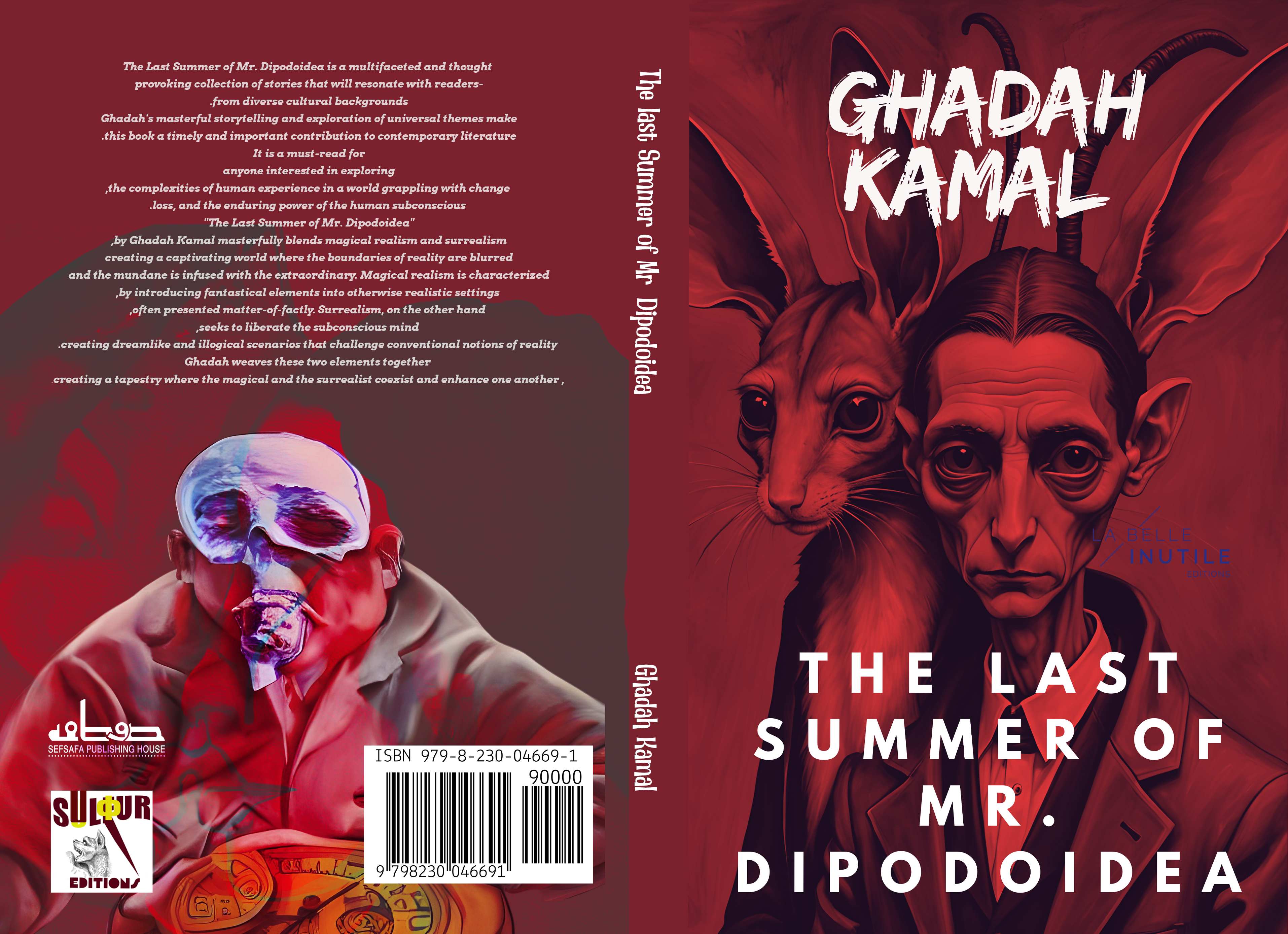
“The Last Summer of Mr. Dipodoidea,” by Ghadah Kamal. ESSAY BY MOHSEN EL BELASY
“The Last Summer of Mr. Dipodoidea,” by Ghadah Kamal, published by Sulfur Editions, presents a unique literary experience that defies simple categorization as a traditional collection of short stories. Instead, the book operates more like an unusual novella or a series of interconnected stories where characters and themes subtly intertwine, creating a rich tapestry of surrealist narratives.


The book’s structure is not immediately apparent, as it presents a series of seemingly disparate stories: “The Last Summer of Mr. Dipodoidea,” “The Phantom of Melatonin City,” and “Tangerine’s Memory”. However, a closer reading reveals a deliberate and intricate network of connections. These stories are not merely placed side-by-side but are rather interwoven with recurring motifs shared themes, and characters that appear, sometimes fleetingly, in multiple narratives. This creates a sense of a shared universe, where each story is both self-contained and an integral part of a larger, more complex whole. The theme of dreams is prominent throughout the book. Dreams are presented as a space where reality and imagination blur and as a source of both inspiration and torment. The line between what is real and what is a dream is often blurred. Additionally, the sense of loss, of something irretrievable, permeates all the stories. This loss manifests in different ways: the loss of a loved one, the loss of innocence, or the loss of creative drive. Characters from one story might reappear in another, albeit in different roles or contexts. Mr. Dipodoidea (also referred to as Mr. Jerboa), initially the protagonist of the eponymous first story, becomes a recurring figure, a name or a presence that echoes through other stories. This interconnection of characters reinforces the sense of a single, albeit fractured, world. References to the “Melatonin Ghost City”, create an alternate dimension that seems to exist outside of the immediate reality, allowing the book to cross boundaries between physical and psychological spaces.
Mr. Dipodoidea/Mr. Jerboa: He appears as a factory worker who is marked for a mysterious end. His journey is characterized by a sense of resignation and acceptance of a fate he does not understand, which contributes to a general atmosphere of melancholic surrealism in the book.
The Young Woman: She is a central figure across different narratives, presented as both a novelist and a doctor. Her experiences with loss and her exploration of creativity as a means of confronting that loss are crucial themes in her story and in the book as a whole. Her novel, “The Last Summer of Mr. Dipodoidea”, functions as a literary ‘mise en abyme’ within the text, suggesting that the stories are part of a greater creative universe.
The Writer: The writer’s struggles with censorship and the incompleteness of his dreams are explored in his story. He is forced to compromise his creative vision. This adds another layer to the book’s reflection on the nature of artistic expression and the forces that threaten it. His loss of his cat, Lorca, mirrors the broader themes of loss throughout the book.
The hidden thread connecting these characters is their shared struggle with loss, the nature of dreams and reality, and the creative process. The characters appear to be different aspects of a single creative consciousness as the stories reflect the internal landscape of a writer exploring the world through her own unique lens.

The surrealist aspects of the stories create a space where the reader is invited to question the nature of reality and the boundaries of what is possible, exploring the subconscious through symbolic imagery and dream-like sequences. The book uses surrealism as a method of exploring the complexities of human emotions and experiences, specifically loss and desire.
The emphasis on writing and the creative process suggests that imagination is a powerful force that can both shape and transform reality. The characters often use their imaginations to create new worlds, to cope with loss, and to seek meaning in their lives.
The theme of death is ever-present in the book, highlighting the fragility of human existence and the transient nature of life. Through various characters and stories, Kamal explores the way that human beings navigate their understanding of death, grief, and the fear of oblivion.
Ghadah employs several modern experimental techniques in the narration of “The Last Summer of Mr. Dipodoidea”, creating a distinctive and unconventional reading experience
•
Fragmented Narrative Structure: Ghadah’s narrative does not follow a straightforward, linear progression. Instead, the stories are presented in a fragmented manner, with abrupt shifts in perspective, tense, and time. This mirrors the way memories and dreams often surface, not as a continuous flow, but as disconnected images and sensations. This technique challenges the reader’s expectations of a traditional narrative and creates a sense of unease and uncertainty. Though presented as separate stories, the narratives are interconnected by recurring motifs, shared characters, and thematic concerns…. This creates a sense of a shared universe where each story is both self-contained and an integral part of a larger whole. For example, Mr. Dipodoidea appears in multiple narratives6…, and the “Melatonin Ghost City” is a setting that recurs throughout the book…
•
Ghadah frequently blurs the line between what is real and what is a dream or hallucination…. This technique is most evident in the surreal elements that permeate the book where characters experience dream-like sequences and move between different states of consciousness6… The narrative also presents a world where the boundaries between life and death seem permeable. The character of the young woman, a doctor who also writes a novel titled “The Last Summer of Mr Dipodoidea”.., creates a meta-narrative layer. The novel within the novel reflects upon the nature of storytelling, blurring the line between fiction and reality, and suggesting that the stories in the book are part of a greater creative universe.


Ghadah uses surrealism to explore the subconscious and the complexities of human emotions and experiences. This is evident in the symbolic imagery, dream-like sequences, and the bizarre or irrational events that occur throughout the book…. This approach challenges conventional notions of time, space, and causality, and allows the author to explore the boundaries of human consciousness…. Certain phrases, images, and events are repeated with slight variations throughout the stories, contributing to a sense of circularity and echoing the cyclical nature of dreams and memories…. This technique also highlights the themes of loss and the search for meaning.
Ghadah uses symbolism to create layers of meaning. For instance, the red bag carried by one of the characters contains fragments of her past and future, representing the weight of her memories and dreams…. Other symbols such as the frog and the Melatonin Ghost City also create multiple layers of meaning….
•
The narratives frequently shift focus away from external events and towards the internal landscape of the characters, exploring their thoughts, feelings, and perceptions. This introspective approach allows the reader to delve into the psychological depths of each character….
These techniques contribute to the book’s unique style, blurring the lines between the real and the imagined, the conscious and the subconscious, to create a powerful, layered reading experience. The narrative techniques in “The Last Summer of Mr Dipodoidea” serve to enhance the book’s exploration of complex and nuanced emotional states
The Interweaving of Death and Sexual Desire in “The Last Summer of Mr. Dipodoidea”
Ghadah Kamal’s “The Last Summer of Mr. Dipodoidea” explores the complex relationship between death and sexual desire, portraying a world where these forces are intertwined within a narrative of rebellion, loss, and forbidden longing. The novel depicts a society controlled by the oppressive Bat State, where dreams and desires are suppressed, and where love and sexuality are both regulated and feared. Within this setting, the characters grapple with the tension between their innate desires and the state-imposed restrictions, often finding that their most intense experiences of passion are inextricably linked with the shadow of death
Dystopian Suppression and the Eroticisation of Rebellion
In “The Last Summer of Mr. Dipodoidea,” the Bat State controls every aspect of life, including sexual expression, which is rationed and reduced to a sterile, chemically induced experience. This repression creates an environment where desire becomes a dangerous act of rebellion, and where any genuine expression of love is deemed a threat to the state’s authority. The Melatonin Ghost Group, a band of rebels, embodies this defiance. By clinging to their dreams and desires, they challenge the Bat State’s control, and their forbidden longings become potent symbols of resistance. The story of the girl and her lover, a leader of the Melatonin Ghost Group, illustrates this perfectly. Their clandestine relationship, fuelled by passion and defiance, is always under the shadow of the state’s oppressive laws .
The novel depicts how the state’s suppression of dreams and desires paradoxically eroticizes them. Because genuine sexual expression is forbidden, the characters are shown to find ways to connect in a world that seeks to erase intimacy, creating a sense of heightened desire within a dangerous context. This can be seen in the ways the characters express their longing, often in secret or in dreams, as they attempt to reclaim their sexuality and identity in the face of totalitarianism. For example, the state rations sex to “twice a month in three-hour doses of chemically induced desire”.
Dreams become a crucial space for the characters to experience their desires freely, unconstrained by the Bat State’s laws However, this freedom is also dangerous as the state attempts to control even the characters’ subconscious by distilling dreams. In one instance, the girl remembers a vivid dream where she expresses her desire for another woman, including kissing and licking her body. This underscores how the repressed desires find their outlet in the dream realm. The intimacy and intensity of the dream are heightened by the awareness that such an experience is forbidden in their reality. The dream and the memory of it, are so powerful that they cause her to mix her dream and bodily fluids, generating a “sire-enforced melatonin bed,” suggesting a powerful merging of the subconscious and the physical.
The looming presence of death further intensifies the expression of desire in the novel. The girl’s lover, a rebel leader, is publicly executed. Her memories of their love, interwoven with the knowledge of his death, create a poignant and tragic portrait of passion under oppression. Even after his death, her love for him persists, a “secret defiance that could cost her everything” The Melatonin Ghost Group’s practice of recording their dreams in notebooks meant to be discovered even if they are all killed highlights how their forbidden desires become a testament to their rebellion against the oppressive state. This demonstrates how the possibility of death only enhances the importance and power of their longings, making the preservation of their dreams a priority.
The stories also depict instances of unconventional desire as a form of rebellion. The love between women, as seen in the girl’s dream, challenges the heteronormative constraints of the Bat State, further demonstrating the characters’ active pursuit of personal freedom. The girl’s attraction to her dream lover becomes so intense, that it prompts her to act in ways she never has before, such as eating breakfast naked, to claim her desire for herself. The character Passion, whose name itself embodies the novel’s themes, embodies the struggle with desire in a state that seeks to erase it. Passion struggles with mental health issues, haunted by “empty dreams and a lack of desire,” as if she has internalized the state’s repression of desire. However, her eventual decision to embrace her desire, even in small ways, showcases a powerful form of self-assertion.
There are other instances in the novel where unconventional desires and identities subvert state control:
- Mr. Dipodoidea’s physical features mark him as different from others in his society. He has “long, pointed ears and large, round eyes,” and is referred to as a “Dipodoidea”. His physical difference is linked to wisdom, knowledge, and an ability to perceive the world uniquely. His story becomes a vehicle to explore how the state treats those who do not conform to its norms. His transformation into “Mr. Jerboa” and his affair with Aracnē suggest a rebellion against the constraints of his society, but also a way for him to embrace his identity.
- Lorca, the hashish dealer, also subverts gender roles and expectations by wearing dresses at night. His identity as an artist and his open disregard for social norms make him a figure of rebellion against conformity. This subversion also extends to how he engages with the world through his art and his drug dealing, which can be seen as a rebellion against conventional modes of living and social expectations.
Death as Transformation
- The story of Arachne: In Greek myth, Arachne is turned into a spider, and in the novel, she is a spider with a woman’s face, who is the companion of Mr. Dipodoidea’s friend, Lebba. In the end, she transforms into a beautiful woman with a “body like an oak tree,” after Mr. Dipodoidea’s friend sacrifices himself for Dipodoidea. She and Dipodoidea then merge into a new being through their desire, suggesting that death can lead to metamorphosis.
- The narrative of Mr. Dipodoidea: The novel blurs the lines between life and death as Mr. Dipodoidea contemplates his fate, and experiences a merging of his atoms with those of Aracne, suggesting that his death was stolen by his friend, Lebba. His final act of killing himself and his mother suggests that death may be seen as a way out of the oppression of life and a means to escape the state’s control.
The worlds of the book demonstrate various forms of expression and communication, including written text, visual art, music, performance, and symbolic acts.
you will find various examples of written text, including stories, poems, news articles, and personal writings. Characters also use written notes and letters to communicate.
you will find The Characters express themselves through drawings and paintings, which are also used to record dreams. There are also descriptions of sculpture and other forms of visual art.
you will find Music is a form of communication and expression and a way for characters to explore and convey their memories and feelings.
The stories depict various forms of performance, such as storytelling, dance, and theatrical performance. These performances communicate ideas and emotions to an audience.
also, Characters use symbolic acts to communicate, such as giving gifts, eating tangerines, wearing specific clothing, and the use of masks. These acts often convey hidden meanings or emotions. Dreams are also a form of communication and expression, often reflecting subconscious desires, fears, and memories.
and Characters use body language and are sensitive to smell to communicate unspoken messages. The characters use spoken language to communicate directly.
Ghada’s stories are set in recognizable, often mundane environments such as factories, alleyways, and city apartments, but these spaces are constantly infiltrated by elements that defy the laws of nature and logic. For example, Mr. Dipodoidea’s long, pointed ears, which are described as being like those of a Dipodidae, place him within a recognizable biological family, but his ears are also seen as a source of protection and wisdom, blurring the line between the natural and the supernatural. Similarly, the “Alley of the Mother of Smells” is a realistic urban space that is transformed by the annual rain that carries the scent of perfumes, which only the residents can smell, a clear example of the blending of the real and the fantastic. The stories present extraordinary events as commonplace occurrences. The character Anansi, a hybrid creature with the head of a bird, the nose of a wolf, and the body of a hippopotamus, is introduced into the factory setting without much explanation. Similarly, the character Aracnē, a girl with four legs and a backward head, is portrayed as a familiar figure to one of the characters. These elements of the marvelous are not questioned but are integrated into the narrative, suggesting a world where such occurrences are part of the accepted reality.
The stories frequently play with the perception of time and space. The residents of the alley measure time by the smell of food, rather than by clocks. The character in “The Man Who Ate the Watch” appears to experience time in a distorted fashion and also to be outside of the normal experience of time. There are also instances where characters slip between different locations, or experience sudden shifts in setting, creating a fluid and unstable sense of space.
Ghadah incorporates elements from various mythologies and folklore, enriching the narrative with layers of meaning. Anansi is a character from Akan folktales, and the story of Arachne is drawn from Greek mythology. The mention of the Egyptian god Khnum adds another mythological dimension to the stories. This infusion of myth and folklore gives the stories a timeless quality and suggests a deeper connection to collective human experience. The story of Fehima, a mythical creature who appears at night with her crocodile jaws, adds a further element of folklore.
Ghadah’s writing is rich with sensory details, particularly those related to smell, which play an important role in creating a surreal atmosphere. The factory is described as a “fortress of scents”, and the alley is named “The Alley of the Mother of Smells” due to the unusual rain that carries specific perfumes. The use of strong olfactory imagery enhances the sense of immersion and creates a world where sensory experience is heightened.
Dreams are not presented as separate from reality but as a parallel dimension that shapes and influences characters’ lives. Mr. Dipodoidea’s dream in which he is accused of being a disruption in the evolutionary chain, blends into his waking reality. The woman in “The Phantom of Melatonin City” experiences a reality in which dreams are banned, which demonstrates the importance of the dreamworld to human experience and self-understanding. Similarly, the character Passion reflects on her dreams and their connection to her waking life.
While using fantastical elements, Kamal’s stories also offer commentary on social and political issues, such as the abuse of power, the suppression of individuality, and the struggle for freedom. The dystopian world of the Bat State, where dreams are forbidden, can be interpreted as a critique of authoritarian regimes. The exploitation of factory workers by their manager, and the character of Anansi being used for wealth and power are examples of how the real and the magical combine to offer social commentary.
The stories often leave questions unanswered and create a sense of uncertainty. The reader is not always given clear explanations for the strange events that occur, and the boundaries between reality and illusion are constantly blurred. This ambiguity encourages the reader to actively participate in the construction of meaning.
By employing these techniques, Ghadah Kamal creates stories that are both deeply engaging and thought-provoking. The blend of the real and the magical in her work allows for an exploration of complex themes of identity, memory, and the human condition in a way that is both unique and compelling.
MOHSEN EL BELASY /SULFUR EDITIONS
GET IT NOW


paperback
$17.00

Paperback /E Book
$17.

Paperback
$20.40

Leave a Reply