
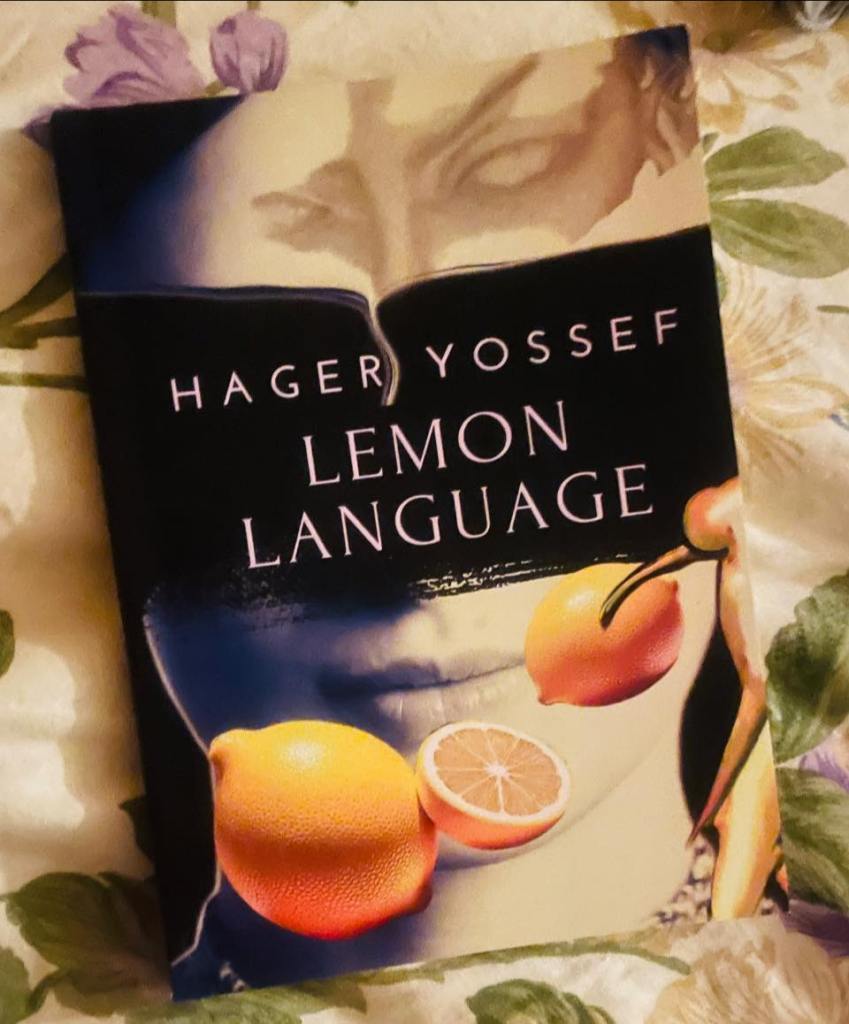
The book Lemon Language by Hager Youssef published by Sulfur Editions

While the title suggests the importance of the lemon, it does not appear directly as a symbol within the poems themselves. The absence of lemons might be symbolic, indicating a “sour” or bittersweet quality to the themes explored in the collection or perhaps a hidden or absent core that the language circles around.
The body is a central symbol, often portrayed as a site of vulnerability, desire, and transformation. In “A Body Like a City,” the speaker compares their body to an urban space that is “structured, refined, cubic—yet barren, without a soul”. This conveys a sense of alienation and a search for meaning. The body also appears in the context of love and desire, such as in “To Familiarize Yourself with My Body” where the body becomes a landscape for exploration and understanding, and the speaker grants the skin “a mind” to think when touched. In “Your Mouth and My Body”, the speaker’s body becomes a “plate” for the lover’s mouth, a “spoon”.
Language is depicted as both a tool for connection and a source of limitation. In “I Never Wanted to Be a Writer,” the speaker acknowledges the necessity of writing to express feelings for another. The poem “How Can I Leave You?” highlights the power of language to create and preserve memories of love, stating “When I loved you, I befriended my language, and it, in turn, documented everything in writing”. Conversely, language can also be a barrier, as seen in “Every Time My Self Strips Bare”, where the speaker uses “words worn out”, revealing the limitations of language to fully express inner states. The author also expresses “the limits of language itself”. The poem “Bombed Poetry” speaks to the power of language, of “my poetic images a cure for barren deserts,” and a means to “heal the wounded”.
Time is a fluid and often oppressive force within the poems. In “Ten Love Letters that Multiplied,” the speaker notes, “Time caught me today, and now I’m stuck in the fading light of evening”. The speaker struggles against time’s constraints and searches for moments of timelessness or eternity. The use of “tonight” as a recurring motif could symbolize the speaker’s introspection in the dark, where memories and emotions surface and time becomes more abstract. The poems often explore the past, present, and future, often blurring the boundaries between these states.
The natural world is evoked through symbols such as water, trees, birds, and the sky. In “Once, I Was a Gallon of Water,” the speaker embodies water in various forms, suggesting the fluidity and transformation of the self. The speaker in this poem also notes “my limbs were fish” which also connects to the symbolic idea of water. Trees often symbolize shelter and refuge, for example, “You are like a home, like a book, like the shade of a tree”. Birds are used to depict freedom and yearning. In “My Breasts are Nest,” the speaker’s breasts are a nest, and the lover’s lips are migrating birds. The use of contrasting elements, such as “sky upon sky upon sky” paired with “dry land” and “water” further demonstrates the symbolic nature of natural elements throughout the collection.

Light and Dark: Light and darkness are recurring motifs representing knowledge and ignorance, clarity and confusion, life and death, hope and despair. Light is often associated with positive attributes like love and understanding, while darkness signifies fear and uncertainty. In “The Sky Gives Birth to Clouds”, the speaker’s mother’s hand “wipes the darkness of your shadow from my face” and the speaker notes “This is the night”. In “A Poem in the Mouth of Dawn”, the speaker states “The night’s face is fearful, the rod of hope stands firm, behind the rear of death”.
Structure: The poems in Lemon Language predominantly employ free verse, allowing for a flexible and unconstrained exploration of emotions and ideas. This lack of formal structure mirrors the fluidity of the themes, reflecting the unpredictable nature of experience and the exploration of subjectivity.
Fragmented narratives: Many of the poems feel fragmented, mirroring the speaker’s disjointed and sometimes contradictory thoughts and feelings. This structure reflects the complex and non-linear nature of memory and experience, which the speaker often grapples with. The poems are not bound to narrative progression, rather, they follow the logic of feeling. This structure allows for associative leaps and digressions, creating a sense of intimacy and vulnerability. Repetition is a common device, employed to emphasize certain ideas or emotions and to create a sense of rhythm and incantation. The recurrence of “Tonight” and “Like” in many poems serves to highlight their significance and creates a sense of ritualistic exploration of love and self. For instance, many poems begin with “Tonight” which situates the poems as introspective reflections. The use of “like” as a comparative tool creates vivid images, and further allows exploration of the internal state of the speaker.
Many poems are structured as direct addresses to an absent lover, creating a sense of intimacy and yearning. This also positions the reader as an intimate confidant. The use of direct address allows the speaker to explore their own identity and feelings through the lens of this relationship.
The poems often shift between different perspectives and voices, creating a sense of polyphony and complexity. The speaker moves from self-reflection to direct address, to observation of the world around them, reflecting the multi-faceted nature of human experience. The poems grapple with the complexities of love, portraying it as both a source of joy and pain, connection and separation. There is an emphasis on love as a transformative experience that shapes identity and understanding. The poems explore the way that love can reveal one’s own vulnerabilities and insecurities, often in the context of relationships, such as in “Ten Love Letters that Multiplied”. Throughout the collection, the speaker grapples with questions of selfhood and identity, often feeling fragmented and uncertain. The poems explore the different roles and masks one adopts and the desire for authenticity and self-knowledge. The speaker compares the self to a variety of things, such as “a small house”, a “kite lost in the wind”, and “a wall before a mirror” suggesting the many different facets of the self. The speaker often asks what the self is to the external world. The poems frequently confront the themes of death, mortality, and the inherent absurdity of existence. There is a sense of urgency and a desire to find meaning in the face of these realities. The use of images such as “guillotine” and “a clean death” conveys the speaker’s contemplation of death. The theme of mortality is often coupled with a sense of the limitations of language and understanding, and a search for transcendence. The speaker also seems to be working through the fear of being forgotten. The collection reflects on the paradoxical nature of language, acknowledging its power to shape experience while simultaneously being limited in its ability to capture the full range of human emotions and thoughts. The speaker, who is a writer, grapples with their relationship to language, both as a tool and a constraint, for instance in “I am Going to Marry a Poet”, and in “My Thoughts, Incredibly Indian”. The poems also consider the relationship between language and experience, questioning whether language can truly represent reality. The poems often find profound meaning in everyday moments and objects, elevating the ordinary to the level of the philosophical. Things like “rugs, chairs, tables, your keys, and toothbrush” take on a deeper significance through their association with a lost love. The speaker finds poetic meaning in the details of their daily life.
SULFUR EDITIONS

get your copy now

Paperback/E Book
$13.00

E BOOK
$4.99
Paperback
£11.49



 SULFUR EDITIONS
Leave a comment