


Guy Girard / Paris surrealist group
Translated by Pierre Petiot
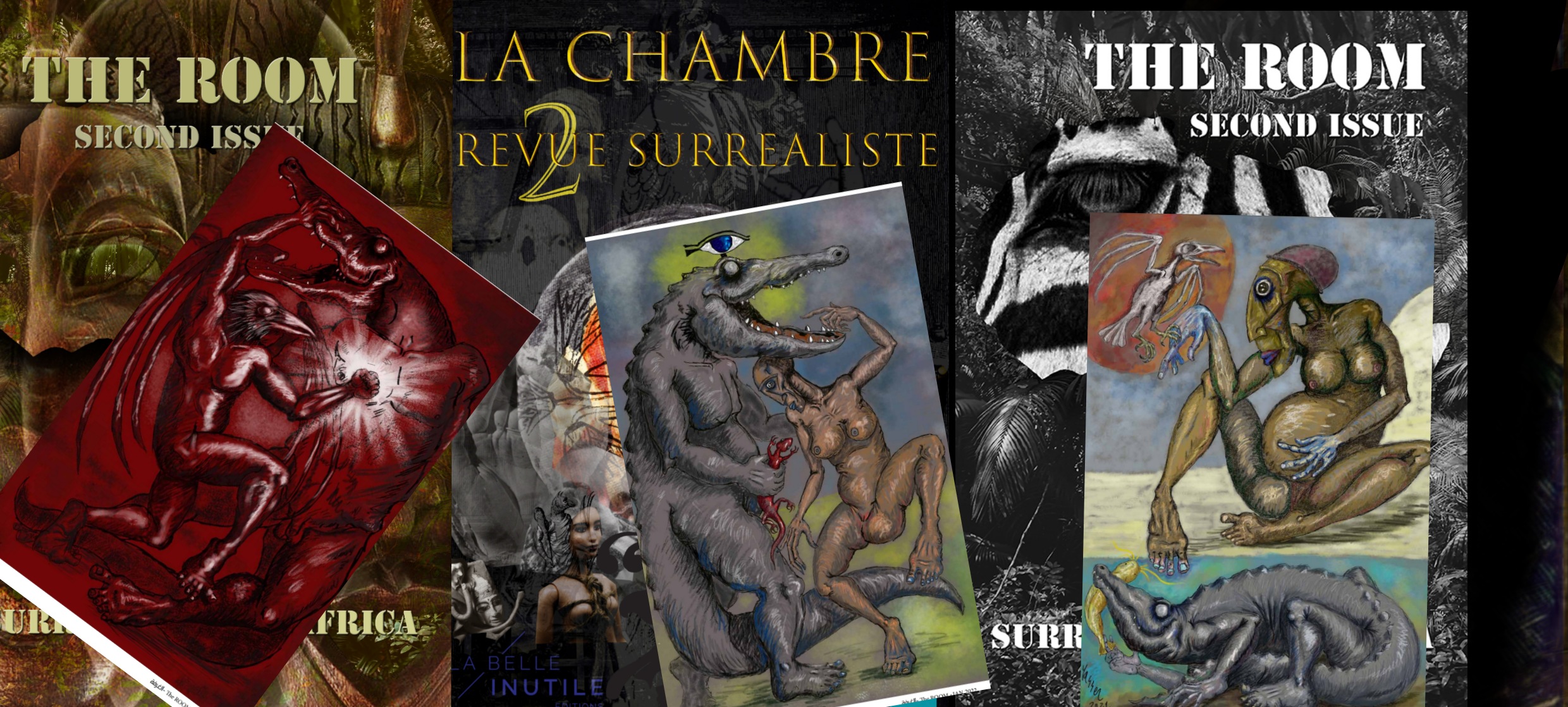
THE CROCODILE GAME
Digital painting by
Yasser Abdelkawy
Published in the English version of the second issue of the Room surrealist Magazine
Free pdf
The Second Issue of the Room surrealist Magazine
Surrealism and Africa
Book 1
https://drive.google.com/file/d/1NfbvALJ_4lnROl_qedlhjEZ1ku64JR-X/view?usp=drivesdk
Book 2
https://drive.google.com/file/d/1xwsTfTMxWdgJ9FEQEBbN-nfWAl25GLmK/view?usp=drivesdk

“The individual psychological possibilities of the often complete annihilation of a vast mythical system coexist with the no less frequent and well-known possibility of finding existing archaic myths in later times, through a process of regression. This means, on the one hand, the affirmation of certain symbolic constants of unconscious thought, on the other hand the fact that this thought is independent of any mythical system. So it all comes down to a question of language: through unconscious language we can find a myth, but we are well aware that mythologies are changing and that a new psychological hunger with a paranoid tendency exceeds at every opportunity our often miserable feelings. »
René Crevel, It’s Mythology That Changes (Golden Age Program)
It is open to assertion that a myth can be considered as a collective dream invented by a community to give meaning to its expectations in a world where the succession of days and nights are also loquacious. Even though the status of dreamlike activity and the possibility of its interactions with daytime life differ from one society to another, from one civilization to another, from a people of awake sleepers to a people of sleeping watchmen, it is possible to interpret myths in the manner of dreams and dreams in the manner of myths: the various currents of psychoanalysis have thus founded the reason for their anthropological hopes, and surrealism in somewhat analogous practices discerns the way in which one must go through to find one’s way in the oneirocritic territories where the sublime point is marked. It occurred to me that it might be possible, in the mode of an interpretive game, to take hold of a mythical narrative and analyze it as if it were that of a dream made during a recent night. As the first issue of Alcheringa attests, the Parisian surrealists have in recent years already played to interpret not only each other’s dreams, but also other individuals whose identity was first hidden, agreeing to pretend that these dreams came from their own unconscious. Following these experiences of intersubjectivity, here is now a game about the interpretations by individual psyches of a mythical narrative developed by an entire community. Without worrying too much, for the moment, about the differences between myth and tale, I proposed to the sagacity of some surrealist friends the text below that summarizes an African tale transcribed by Henri Gougaud in his book L’Arbre à soleils (The Sun Tree).
***
OMBURE-LE-CROCODILE CROCODILE
Long ago, the Fan people used to live on the banks of a large and wide river. Their circular village, made of wooden huts, was established between this river and the deep forest. But on the edge of this river lived a huge and horrible crocodile, named Omburé. His scaly skin was stronger than iron, the teeth of his terrible mouth were as sharp as razors. When he yawned, all the animals near the river, and even elephants, trembled. Omburé was one of those monstrous ancestors created before men, with great knowledge and power similar to that of the gods.
Always hungry, he one day had the idea to go to the village of the Fans. Standing in front of the hut of the Fan Chief, he declared that he wanted to be offered each day alternately one man and one woman, to eat them, and a young woman with each new moon. Otherwise, he would immediately devour the whole village.
The Fan people submitted: how else can could their do ? The monster was invincible. So, a man randomly is delivered to the beast near the river, and then a woman on the next day. The weeks pass, desolate, until the chief of the tribe gathers the council of the elders so that they together decide that their people will leave this village to flee into the forest. So, at nightfall, everyone goes away.
The next day, Omburé-the-crocodile arrives at the deserted village to claim its prey that was not delivered on the riverbank. But there is no one left! Where are they? Back in his reed den, he summons the spirit of the waters, great-golden-fish, which informs him. Omburé then crosses the forest, for days and days, and he arrives on the other side, where the Fans have built their new village called Akurengan, which means deliverance-of-crocodile. Omburé furiously walks past the chief’s hut. He then requires to be provided with either two men ot two women every day. And he required to be given the Chief’s daughter on this very day !
The Chief’s daughter then shows up; Omburé grabs her and leaves the village with her. But charmed by her melancholic beauty, he does not devour her. He makes her his wife. A year later, their child is born, who is named Gurangurané. Seven years later ; the child is already as tall and strong as a man. But he hates Omburé his father who, day after day, weakens his mother’s people. So he decides to kill the crocodile. To achieve this, he carves three rocks like giant cups and then fills them with palm wine. Helped by the two men who were meant to be the monster’s prey on that day, he places the three rocks at the edge of the river. When Omburé-the-crocodile comes out of the water, he wants to taste this drink unknown to him and of course he gets drunk and falls asleep. Gurangurané then appears, and makes sure his father is asleep. Squeezing the stone of lightning in his fist, he lays it between Omburé’s two closed eyes and commands him: “Strike, stone-of-the-flash.” A lightning bolt erupts like lightning that pierces Omburé’s powerful skull and kills him.
Then all the Fans arrive, dancing and singing to express their joy for being delivered from the crodocile, but also to soothe his spirit. For Omburé the Ancestor must rest in peace.
***
And now here are the interpretations made by the participants in this game. These analyses are of course dependent on the complexity of each person and his preferences for modes of investigation, whether offered by psychoanalysis, comparative mythology, the paranoid-critical method or the mechanisms of humor.

Jason Abdelhadi:
The riverside village is clearly a substitute for Ottawa and its river. I had recently looked at pictures I had taken of small sand huts made by children on a nearby beach, which could have been a reduction of the city into a tribal village. The Omburé crocodile is derived from a wooden crocodile statue that I had bought from a thrift store. Recently I noticed how twisted its tail is. A few days earlier, I had tried to sleep with this wooden crocodile to provoke tactile dreams, but without real results. I think that on a symbolic level, this could represent a latent phallophobia, associated with sexual anxieties and anxieties regarding the father figure, and at the social level, a terror regarding state-sanctioned police violence, as the media informed us. Alternating male/female sacrifices represent the rhythmic sequence of the sexual act, and perhaps a desire on my part to remove binary gender codifications. This could also unfortunately represent the sequence of police violence against black and indigenous populations. Gurangurané, the crocodile’s child, borrows its shape from a mixture of influences: first, a video I recently watched about a baby crocodile performing a death leap while trying to devour a carcass much larger than him, and secondly mythical characters seen in various adventure cartoons. His use of lightning to kill his violent father’s goinfre is certainly on the mythical level a model of revolutionary action. The stone itself can relate to my recent fossil research experiments near the Rideau River, where I looked at and manipulated many different stones for signs of the presence of ancient inhabitants.
Michèle Bachelet:
“Omburé, a creature of knowledge and power, you fed on men like Chronos, god of time, devoured his children. We will no longer pay tribute, our coalition led by your son, the fruit of a forced love, has conquered. We follow your reign and divide time between night and day. We, in turn, devour you in the anonymity of the innocent. On the other side of this river an immortal republic thas been set up that we know is toxic. »
This song of men descends on the world like a cloud of birds that forms and distorts us in the same movement. And my image is drawn in the shadow of the species, singular Omburé. I paint you, the first of the godless, metamorphosis of a whole. I watch you in the hunter freed from his prey. I set you up in what comes back from what is still not. I veil you in the vermeille women forgotten in our hearts, like the dull rhythm of vengeful forests. I’m freeing you from the appetites of the world. You’re my little wood crocodile-paper-cutter that sits on the shelf of my library.
Massimo Borghese:
Omburé is the dark, frightening and both sublime and hypnotic nucleus of nature, the Heart of its darkness, its cruel and inhuman internal principle of Total Destruction and Death, and as such, it is ageless, an ancestor that was there long before the appearance of man. Sacred, he appears as an almighty (and omniscient) monster , and invincible Beast, he assumes all the prerogatives of a God who is like a disproportionate Threat of Violence, generating universal fear in all living beings (even the strongest!). It is irretrievably inscribed at the very heart of Time in its infinite flow (the river). On the banks of this river, located at equal distance between him and the Forest, is located my Fan village (it is my citizenship based on a series of impressions of “already seen” as in other eras – according to other myths – that of citizens of Prague or Troy). It is a closed and perfectly circular environment, based on the idea of belonging. Omburé, like God, is always thirsty for the absolute and he must impose his monotheism on the Fans by still proposing himself as pure Power. As such, he then enshrines a Testament Pact that imposes a Law (unjust and inhumane) that binds him to the Fans in a relationship of interdependence. The Obligation is created by Blackmail. Fear of death is the foundation of Power. This Law, inexorable and equal for all (men and women) is however from this moment on, regulated and organized in the manner of an Order, but it has allusively erotic nuances (every month, a young woman) and it introduces a religious and legal dimension of time (days, weeks, according to a new lunar-menstrual calendar of the young women to be to consume). Death thus has its norms, set according to a mathematical sequence.
We, Fans, secretly evade this frightening dependence relationship, which has become intolerable, precisely because of our new “historical” perception of time. We break the law ambiguously, through a subjective defection, the rebellion against death being considered impossible. This defection requires a material and symbolic crossing of a large Space, the immense and obscure protective space of the Forest, crossed as a memorable Exodus and crowned by a Founding Event (in the historical sense of the term): the new village that has the name of the collective enterprise of Liberation.
Omburé appears at first displaced but then, with the help of his information tools which he controls and can summon (the spirit of the Great Golden Fish of Waters, projection of our Fear and Our Guilt), he can locate the deserters of the Law. However, the Crocodile is forced, in order to recover its Power, to complete an unexpected and exhausting crossing of the Great Forest, which highlights its strength but also its potential weakness. Thus, even if he succeeds in imposing a Law that envisages Prescriptions twice as severe, he becomes more and more human, thus weak and can be defeated. From his union with the daughter of Chief Fan, sacrificed, silent and submissive like Virgin Mary, he changes again and his size is reduced to that of Master Father. He now has become my father. I, Gurangurané, a seven-year-old Rimbaldian poet, nourished by a natural Oedipal instinct, I can take over the Father’s murder. The operation is surprisingly easy. It is enough to imagine a rational plan that exploits a basic cause-and-effect relationship, a plan in which the instinctive inferiority and the mistaken self-awareness of my father Omburé collaborates. The stone of lightning is the very power of my Imagination. Its effect is as prodigious and exhilarating as the discovery of automatic writing in a night of lightning. Lightning. The father is dead, time becomes that of the Feast and victory of Utopia, yet it is necessary to prevent the birth of a new religion, that of Reason, but rather to recover the value and anthropological sense of the notion of the sacred. The Ancestor must be respected as such and properly re-established in the common heritage of mythical knowledge.
Anithe de Carvalho: (Miguel De Carvalho?) ed. Note.
We lived on the banks of the thousand-islands river. Where the shadow of Oblivion would surface. You were irreparably invaded by it. Night and day. Shadow of oblivion. Unspeakable monstrosity. Invisible. Its reputation was that of taking away a cell of memory every day for the sole purpose of satisfying his hunger for total emptiness. Beheading the present. Engulfing the past. You had no choice but to give in to this strange thirst for the end of the shadow of Oblivion. Getting lost. Slowly, at low fire. Love. Desire. For a while, you managed to park me in parallel to this breeze of atrophied neurons. But the Shadow of Oblivion has not accepted your lucidness astray. Your struggle to reconnect with the past. Your strength to contain the present. The monstrosity then demanded all the memories you had of our skins. Your brain at once without any irrigation. Uprooted. Shadow of oblivion now owns you. At night. At the center of the flow. Rains the thirst for the immutable in the silence of disorder. But. The Us was. You off. I’m the only one. Here. Another I is coming. After seven years, this I takes his revenge on the Shadow of Oblivion. Throws a projector of disconnections at him. Conjures the abyss of the draft of affliction. Finally. No longer fear the irrevocable darkness of the abyss of self. End of the silo of nights flooded with endless farewells. With thd tearing with the hilarity of a sparse unconscious. End of the sudden permanent delirium. Our ash skins are nesting a carrot at the legs of the coronary maple. In the shadow of oblivion.
Claude-Lucien Cauet:
I wonder what Supercroco wants to mean to me by respecting parity during its daily meal, a man, a woman, a man, a woman…, plus a young woman every moon. This kind of monster is common, even banal. If you try to escape, Supercroco finds you and claims double ration with, as a bonus, the chief’s daughter. Then, it is the miracle of love, quite banal too, Beauty and the Beast. Supercroco falls in love with the chief’s daughter and, as a result, makes a child with her. You don’t have to visualize the scene, it’s rough. It is said to be the “primitive scene” for the begotten son, and that is where it all begins.
I’ll tell you: I killed my father, Supercroco, who was the image of the chief for my mother. But it is not out of jealousy or to become a leader in my turn. That’s because I’ve been a big fan of women since I was a kid. When I saw my parents, I thought I’d never be a crocodile. I was fulminating at the idea that a woman can “give herself” to a monster. I am in the grip of a fantastic revolt when, moreover, she gets engrossed by this abject, ugly, stupid monster; especially if I am the product ejected from these exorbitant nuptials.
I’m freaking out. After his fraudulent fornication with the white bull, Pasiphae gives birth to the Minotaur. With Cerberus, she’d probably get a zombie. With the Leviathan, also called the “State”, the result would be a young wolf… Fortunately, I’m “normal,” like my mother. That’s why I was able to kill my father, like everyone else. But it was still Supercroco, and I had to wait for him tio get drunk in order to make him swallow a DIY atomic bomb in the kitchen. He thought he was taking a pill for his headache. When I saw him scatter into small pieces in the cosmos, he was no longer a monster and I felt a great tenderness for him with. I’m sure he’s forgiven me and, ultimately, I’m proud of my father.

Joel Gayraud:
Without hesitation, as obviously, I identify the Fans with my desires, my aspirations, my nostalgia, my regrets. The river that borders their village symbolizes the flowing life. And the wooden huts that make it up represent the steps on the way to my own life. As for the forest, it contains all my nocturnal dreams, and the whole black continent of my unconscious.
Omburé the crocodile is the principle of unilateral and cruel reality, which has instrumental reason as its weapon, and makes the reminder to the law its watchword. Every day he demands that he be sacrificed a pleasure or a passion. Its sharp teeth exhibit the constant threat of castration.
Fleeing his sermons and objurations, I plunged into the forest of my unconscious in pursuit of utopia. Soon I began to build it as an idea on the other side of the river of life: these were the years of revolt, drift and struggle. But Omburé caught up with me and I had to sacrifice to him twice as many pleasures, dreams and desires. Fortunately, Poetry, which he believed he could submit to his law, succeeded in softening him. From their inconceivable mating, I was born a second time. Having reached the fullness of my new childhood, I put the crocodile of reality back to sleep by making him drink the wine of dialectical criticism. And with the lightning stone of the imagination, I succeeded in making him harmless, definitely.
Guy Girard:
When, as a child I was spending my summer vacation with my grandmother, I liked to accompany her when she went to fetch water from the well, which was not far from her house. A mysterious operation it was! For this well, like many others in this region of Normandy, similar to a miniature turret, was usually enclosed by a small door closed by a latch, and it housed at the bottom of what was then for me an abyss, a crocodile! An imaginary scarecrow invented by my grandmother so that I would not lean over the margin, at the risk of falling: but of course, every time the well was opened, I had to try to see the monster that the fall of the bucket was probably annoying. And sometimes I would only annoy him even more, throwing small stones at him.
Was this crocodile Omburé himself ? Or rather, since the mythical monsters have various appearances depending on the climates to which they bring meaning, was it not an image of the dragon which, according to local legend, terrorized the population of the village before the future saint of the parish came to impose a more devious terror, Christianity? This dragon sheltered under the cliff in a vast cave, the Baligan Hole, which, as a child, I did not approach without a delicious fright (on this place a nuclear power plant has been built, a so perverted persistence of the Chthonian symbol). As in the African myth, this dragon demanded on fixed dates to be provided with beautiful and good fresh flesh to satisfy his appetite. But it was that of the children of the village who, unlike Omburé, had his preference, if we must believe the only known version of this legend, which is Christian and therefore possibly distorted by the pedophile passions that often drives the priests of this religion, as everyone knows,. Unlike the Fans, my distant ancestors did not have to offer in sacrifice the “melancholy beauty” of the chief’s daughter, a future hero did not have to be born, and the one who played his role, Saint Germain Scott, annihilated the beast either by strangling it with its stole or by drowning it in a pond deep enough for it, called the Citerne and located near the cave. I prefer this version, which allows me to draw an analogy between this Citerne and my grandmother’s well, and his crocodile becoming an avatar of the dragon and thus of Omburé. I leave it to fans of fantastic zoology to determine the genetic cousinings between dragons and crocodiles; however, I observe that objective chance likes to make them neighbors. Thus, a few years ago, I was able to complete a new visit to Mont Saint-Michel a place commemorating the massacre of another dragon by an underling of the Christian god, by that, unexpectedly, of a reptilarium that had recently opened within rifle range of the Mount. I saw crocodiles of all sizes, and caimans, alligators, gavials, all more or less asleep, albeit with one eye and dreaming with nostalgia of the Fans and this scamp of Gurangurané.
Beautiful animals, these reptiles, yet doomed in our lands, before ending up in handbags, to haunt the marigot of post-pubescent terrors, like sharks, giant spiders and the offspring of the beast of Gévaudan. It is up to them in the popular mythology of the industrial civilization to assume the evil role in which agitates, the return of the repressed of a complex “feeling of nature” made of anguish, hatred and an unspeakable nostalgia for an immemorial harmony, this undrinkable cocktail with which the ecocidal paranoia accompanies the march of this world is intoxicated. An easy game for the industrial civilization popular mythology to hide in the bloody appetites of these monsters a simple fear of castration: Would Omburé be returning today in our cities, it is no longer under his magnificent scaly defroque that he would imperially come forward to claim his tribute, but insidiously, invisibly in the form of a virus. Covid 19: crocovid 19, yes! And the masks once needed by the Fans to ritually celebrate Gurangurané’s victory, what pitiful ersatz replace them today, who are worn to shelter from the fetid breath of the monster! It is no longer so much the Ancestor that is assimilated to the death instinct, Thanatos, and who alas governs the principle of reality a thousand times more than Eros – but rather, in the heart of the planetary village, the hierarchs who are perpetuating its authority tradition – without, as a counterpart, knowing how to dialogue with the Spirit of the Waters , nor how to wisely use the stone of lightning – that are the cause for these miasma of death to be roaming around. And in the meantime, didn’t Omburé hide in some Jurassic Park?

Michael Lowy:
This myth resembles that of the Minotaur and we need a new Theseus to cut off the heads of all the Ubu-Crocodiles that rule us. Or rather that all the Fan villagers in the world turn into Sea Snakes or Vampires to finish off all the Omburé crocodiles who want to devour them.
Dan Stanciu:
To clarify this story and give it a possible interpretation that could prove fruitful, it seemed appropriate to rewrite it. So here’s a more explicit version.
The Duration-Man (Countdown Tale)
One more day doesn’t make the elephant rot
Fan proverb, in Blaise Cendrars, A Negro Anthology.
In the past, elephants were contagious and lived in great despair, on the side of the departmental road that connects Détresse-Plage to Disarray-sur-Mer. Their despair, made of bitterness and distressing worries, did not stop going round in circles, nourished by a deep misery. But on the side of the road, lurking behind a pile of scrap metal, lived a huge and disgusting human motor, named after the Duration-Man. His skin, hardened by the continuous work of the small intellect, had the color of the tomb, the words of his phonatory apparatus were fetid as official speeches. When he was bellowing, all the cars on the road and even the cyclists were petrified. The Duration-Man was one of those monstrous scarecrows created to revive the throes of hell, with great power of lowering and a pestilence similar to that of the heavens. Always thirsty for emotions, one day he had the idea to go to the Ideal Elephant Palace, a beautiful building erected by Postman Vaché who distributed letters of war in this remote land. In front of the chief elephant, he declared that he wanted to be offered a male elephant and a female elephant alternately each night to torment them accordxing to his fantasies, and with each new moon, a young virgin elephant. Otherwise, he would immediately destroy the palace by fire.
Elephants submit: how to deny him this menu plaisir? The monster is very persuasive. Then a male elephant chosen at random is delivered to the human motor near the road, and then the next day it is a female elephant. The weeks pass, desolate, until the chief elephant gathers the council of infants and they together decide that their flock will leave the palace to settle elsewhere. So at daybreak, they pack their bags.
The next day, the Duration-Man arrives at the abandoned palace to claim his due. But there are no elephants anymore! Where did they fly? Back at his metal scrap heap, he summons the spirit of the orifices, a-holes-pierced large cloison, which briefs him, giving him an update about elephantist acts. The Duration-Man then goes through an energy crisid, for days and days, and he finally arrives on the other side of time, where the elephants have built their new palace called “A toothpick” to evoke the memory of Alfred Jarry. The Duration-Man rushes furiously towards the chief elephant’s office. He then demands to be provided each night with sometimes two male elephants and sometimes with two female elephants. And he asks the Chief Elephant his own grand mother for this very night!
She shows herself dressed in a cobweb made dress that highlights her majestic overweight; the Duration-Man grabs her and leaves with her. But charmed by her weariness that no act of dread dispels, he changes his mind and renounces to inflict the worst abuse on her. He makes her his wife. Three days later their child is born, named Durand the Elder. After another three days, the child is already senile and constantly forgets to button his panties. But he adores the Duration-Man, his father, who constantly reduces the ranks of his mother’s flock. So he decides to prepare a feast for him. To do this, he fills a cupboard with the tastiest dishes: jelly screwdrivers, roasted tires with acetylene sauce, Fricassée of pistons, etc. Helped by the two elephants who were to be tortured by his father that day, he places the cupboard along the road side. When the Duration-Man emerges from his torpor, he is attracted by the delicious aromas that escape from the cupboard and begins to stuff with its content. Then, sated, he falls asleep. Durand the Eldest then appears, making sure of his human-motor-father’s sleep. Clutching the feather-of-ecstasy in his fingers, he deposits it between the two closed-Duration-Man’s wings and commands him: “Tickle, feather-of-ecstasy.” A gentle shudder is heard as the flapping of the hummmingbird’s wings that caresses the Duration-Man’s forehead-and awakens him.
Then all the elephants appear, singing and dancing to express their joy at being the victims of the engine again and to chase away the spirit. For the Duration-Man must be contagious, too.
***
Recently, I was led to reread Maxime Alexandre’s book Mémoires d’un Surréaliste (Memoirs of a Surrealist). I had the amused surprise to come across this story of a dream made by the author while he participated in the surrealist movement: “A pool of white marble, round and quite narrow, which I could see from above, was the apartment of André Breton. Near me stood several of my friends, but more by the certainty of their presence than their visible presence. In the moment when my eyes discovered a heavy green crocodile in the pool, I knew that this crocodile was André Breton, and at the same time I knew that I myself, from that very moment on, I had the power to turn myself at will into a crocodile”. This metamorphosis into a saurian that is now available to him in his dream, Maxime Alexandre, invests it, he insists, with a fantastic power. As the culmination of an initiation, the swimming pool can of course recall the baptistery of the first Christians (remember that the author, of Jewish origin, briefly converted to Catholicism after the Second World War) or similar baptism rites for other sects, all of which betting on the simulacrum of a new birth.
But once cut, would the umbilical cord have better uses, after clever weavings, than its transformation into a net to catch dreams, or into a rope for the Hanged Man in the Tarot? A lasso, perhaps, to capture Omburé in the last line of a surrealist poem? Wouldn’t the totem animal of surrealism, and its powers equally granted by automatism, be the crocodile? There are of course, many other beings, in our mythological bestiary, but let’s bet that this one feeds mainly on soluble fish, before going to convince the whole tribe of Fans who wander around our cafes, of the accuracy of this metamorphosis. And I know that there is one among us who will observe that Omburé, at the bottom of his fearsome mouth, possesses as a tooth of wisdom, the stone-of-the-lightning, which others know as the stone of madness, corner stone of the barricades to come…
July 14, 2020


Leave a Reply